
Read Miami County Deed Records
Every deed accepted by the Recorder becomes part of a much larger land file. Beyond deeds, that file holds mortgages, releases, easements, liens, plats, surveys, and leases. It also holds powers of attorney. Any of these can change how a tract is read. Treat the index as your entry point. The scanned instrument supplies the detail that settles the question.
| Deed Type | What It Does | Common Use |
|---|---|---|
| Warranty deed | Conveys the stated interest with title promises | Ordinary purchase transfers |
| Quitclaim deed | Conveys whatever interest the grantor has without the same promises | Family or corrective transfers |
| Trustee or executor deed | Conveys through a trust or estate representative | Trust and estate administration |
| Sheriff's deed | Documents a transfer after the applicable court-sale process | Completed foreclosure sale |
| Tax deed | May follow statutory tax-sale and redemption steps | Completed delinquent-tax process |
Not every recorded item conveys ownership. A mortgage or lien is an encumbrance, which is a claim or burden on the land rather than a transfer of interest. A matching release shows the encumbrance was later discharged. Read the document itself, its cross-references, and any later releases before you conclude anything.
Miami County's Permanent Instrument Office
The Miami County Recorder handles the scanning, indexing, and microfilming of permanent public instruments. The office sits at 25 N Broadway, Room 205, in Peru. Its published contact is 765-472-3901 ext. 1222, though a county directory also lists 765-472-2573. Call ahead when the number matters. Documents received are generally turned around within 24 hours. Mailed items take longer to arrive and return.
Certified and official copies are both available at the counter. A remote search may not reach the year you need. It may miss a document type or a clear image. That counter is the fallback in those cases. A mail request should name the parties. It should give an approximate recording date and land description. It should cite any known document or book reference and include a self-addressed stamped envelope.
Search Miami County Deeds by Field
The county's remote Tapestry handout lays out the searchable fields. Pair a party role with a date span or legal description. Do not rely on a surname alone. The static instructions omit the full menu of document types. Check the live menu before treating any category as complete.
| Index field | Use in a deed search | Caution |
|---|---|---|
| Grantor | Find the transferor or earlier owner | Test name and entity variants |
| Grantee | Find the recipient or acquiring owner | Separate same-name parties by date and land |
| Beginning / Ending date | Limit the recording period | Recording may follow signing or closing |
| Document number | Retrieve a known filing | Use the Recorder's exact reference |
| Consideration amount | Locate an indexed amount | It does not necessarily equal market price |
| Legal description | Search subdivision, parcel, or metes-and-bounds terms | Historic names and spelling can matter |
Two routes reach the indexes remotely. Tapestry works on a pay-as-you-go basis, while Laredo runs under a subscriber agreement. The county page lists an $8.75 Tapestry search. An older handout says $6.95, though. Confirm the live fee before you pay. Per the handout, an image is included and printing runs $1 per page.
Trace Miami County Grantors and Grantees
The grantor conveys the interest. The grantee receives it. Put in order, these conveyances form the chain of title for one piece of land. Modern entries cite an instrument number, while older books rely on volume and page. Keep every reference. It is the bridge to the next instrument in the chain.
- Find the deed where the present owner appears as grantee.
- Read the grantor, recording date, instrument reference, and full legal description.
- Search that grantor as a grantee in an earlier date range.
- Confirm that the legal description follows the same tract before adding the link.
- Repeat, then move to deed books and microfilm when the remote index ends.
- Grantor
- The party transferring the stated interest.
- Grantee
- The party receiving the stated interest.
- Chain of title
- The linked history of conveyances for one tract.
- Book and page
- A location in a bound or imaged record volume.
- Instrument number
- A unique modern filing reference assigned at recording.
Two Miami County Deed Cutoffs
How far back do the online indexes go? The county gives two answers. The public Land Records page reports that the deed index reaches Deed Book 29, dated 1888. A May 2025 Laredo agreement instead claims deed indexing to 1847, mortgage indexing to 1992, and miscellaneous instruments to 1896. The two statements may describe different systems, tiers, or document classes. The official pages never resolve the difference.
Verify the year before searching. For a deed before 1888, ask the Recorder which portal, subscription level, and document type supplies the claimed coverage.
That gap matters for your search. A no-result lookup does not prove a deed never existed. It may only mean the index you chose stops short of the right volume or instrument class.
Miami County's Earliest Deed Books
The Indiana State Library finding aid pushes the record trail back further. A modern address search cannot reach it. Deed Volumes A and B cover 1828 through 1848. A grantor and grantee index for A-C spans 1843 to 1861. A general index A-C begins in 1841. Miami County was organized in 1832, so several early volumes capture its formative years.
Early land records predate today's parcel numbers and often predate street addresses entirely. Start with a person, a tract, or a township. A survey description or an old town name works too. Xenia later became Converse. Lincoln became Macy. Historic plats, atlases, and State Library microfilm can tie those names to the modern landscape. No official source confirms a catastrophic courthouse fire, so assume no record-loss story.
The State Library is an access channel, not a substitute for the Recorder. Note the microfilm call number and volume span. Use the index to find a book and page. Then request the matching image. City directories, owner atlases, and newspapers can supply a missing name or place clue. The deed itself remains the conveyance record.
Watch New Miami County Filings
The Recorder's property-fraud alert service can notify a subscriber whenever a registered name appears in a new filing. Miami County's official fraud-protection page explains the enrollment.
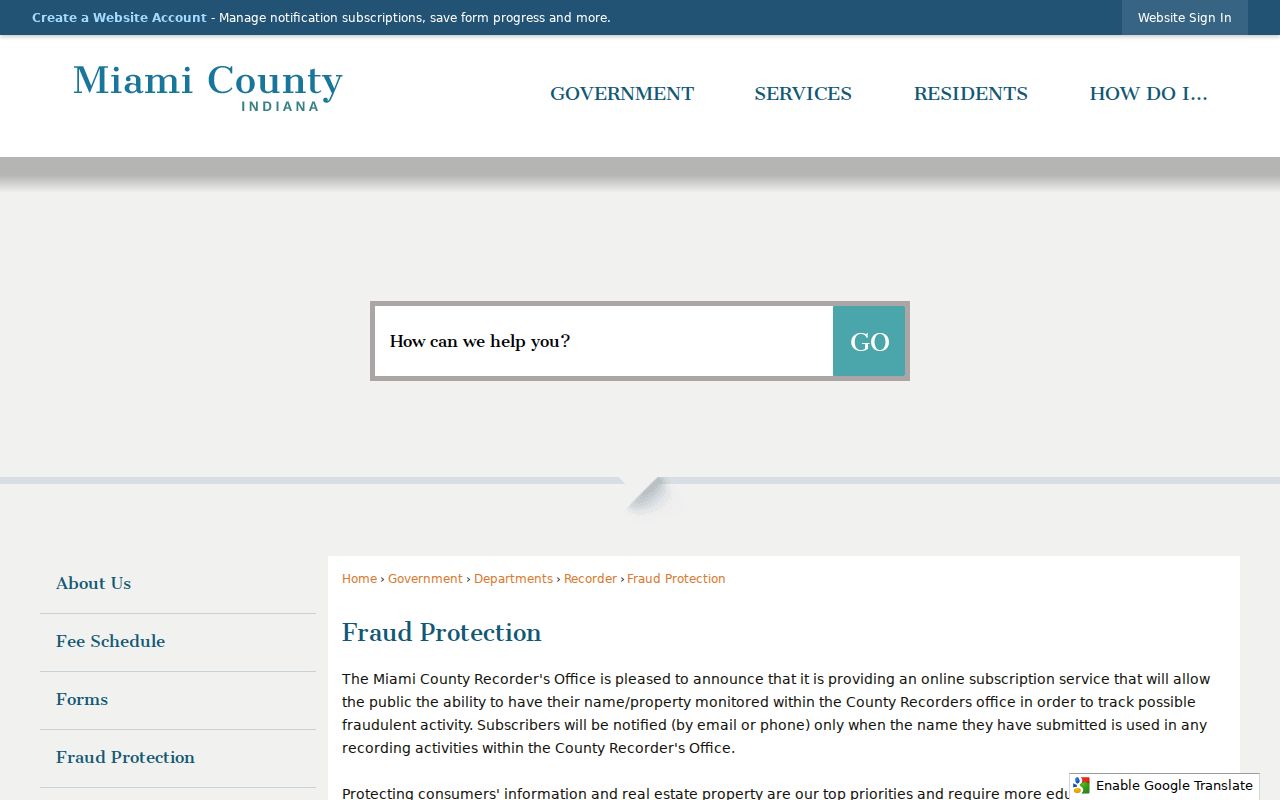
Treat the alert as an early warning only. It blocks nothing. It also proves nothing about fraud, so review the document number and image, then contact the Recorder, law enforcement, or legal counsel if a filing looks suspicious.
Order a Miami County Deed Copy
Remote users can pull an available deed image through Tapestry. Laredo works too, under its subscriber terms. At the courthouse, request the deed by instrument number or by book and page. Copies up to 11 by 17 inches cost $1 per page, larger copies run $5 per page, and certification adds $5, all on the published fee schedule. A certified copy bears the Recorder's certification. It is not a legal opinion of the instrument.
Mail is another documented channel. Include the party names, an approximate year, the document type, and a legal description or recording reference. Add a self-addressed stamped envelope. When an online image fails, Indiana's Access to Public Records Act, Indiana Code 5-14-3, supports a reasonably particular request for an inspectable public record.
Recorded does not mean guaranteed. Miami County deed records show accepted filings, but an index hit is not a title opinion and does not rule out other interests.
Check Miami County Recording Details
Miami County sets clear standards before a document can be recorded. The Recorder asks for legible text, generally at least 10-point type. Printed names must appear beneath every signature. Clean margins are required on the first and last pages. Proper notarization or a stamp is also needed. A preparer statement applies in the circumstances the Recorder describes. An Indiana affirmation about Social Security numbers applies as well. A legal description is required unless the document falls under a listed exception.
Those rules explain why an accepted deed can run several pages with stamps and attached exhibits. They also explain why a one-line index summary is too thin for close review. Go to the image itself for signatures and acknowledgments. Look there too for legal land terms and references to earlier deeds. For a quick lookup, start with an address. Try the focused Miami County property search before diving into the deed index.