
Identify a Miami County Owner
A reliable owner search starts with an everyday street address and works toward the keys that county offices actually use. Miami County spreads that trail across several offices. The Assessor, Auditor, Treasurer, GIS, and Recorder each hold one piece. The free tax-list search makes a good first stop. It helps when the Beacon application will not load. The search accepts an address, parcel number, owner last name, and tax year, and every returned value is worth recording rather than trusting the name alone.
- Normalize the house number, street, city, and ZIP. Search the address in the Miami County tax list or Beacon.
- Copy the parcel number, owner-of-record name, situs address, mailing address, and tax year shown.
- Search the Miami County Recorder index for the owner as grantee and inspect the newest deed tied to the same legal description.
- If the grantee is an entity, compare its exact name with the Indiana Secretary of State business record. If it is an estate or trust, follow the matching deed and court trail.
Two independent county records answer this question. The tax roll is fast and address-friendly, while the newest deed is the stronger record of the transfer that reached the Recorder. A mismatch matters. It often means the roll has not caught up, the parcel changed, or the address points to a different legal tract.
Read Miami County Search Keys
The county's tax-list result lays out District Number, Parcel Number, Name, Tax Year, and Property Address. These fields bridge one office to another. A parcel number narrows the Assessor and GIS side. The exact owner spelling and legal description carry the inquiry into the Recorder index. One caution applies. The result page warns that it is not for official use, so save the tax year and verify important facts with the office that holds the record.
- Owner of record
- The person, trust, estate, or entity named on the current assessment roll.
- Situs address
- The physical location used to identify the parcel.
- Mailing address
- The place where the owner receives notices, which may be far from the land.
- Grantee
- The party receiving the interest in a recorded instrument.
Never merge the situs and mailing fields. An out-of-county mailing address does not prove that someone else owns or occupies the parcel. The deed's legal description stays tied to the land.
Confirm Miami County Ownership
The Miami County Land Records page routes searchers to Tapestry and Laredo. Start with the current roll name as a grantee. Limit the date range. Then match the parcel or legal description to the newest transfer. The latest deed shows who received the recorded interest. A document number from the parcel card speeds the check.
The public land-record page says the deed index reaches Deed Book 29 and 1888, while a 2025 Laredo agreement states that deeds are indexed to 1847. Those official descriptions conflict. Ask the Recorder which tier covers an older deed. At the counter, request inspection first, then an ordinary or certified copy only if needed.
Remote access is not the only channel. The Recorder accepts counter and mail work and recommends a self-addressed stamped envelope for mailed returns. Indiana's Access to Public Records Act, IC 5-14-3, also supports a reasonably particular request for an inspectable record that is not exposed online.
Miami County Ownership Sources
Every source runs on its own clock. Use the table to pick the next check rather than expecting one database to settle every ownership question.
| Where ownership appears | What it gives | How current |
|---|---|---|
| Assessor or tax roll | Owner name, mailing and situs data, parcel and assessment context | Current working roll; tax-year data can lag |
| Recorder deed index | Grantor, grantee, instrument date, and legal-description route | Newest recorded transfer, subject to working-index limits |
| Beacon GIS | Selected parcel, mapped context, and configured ownership attributes | Reference snapshot; confirm with Assessor and Recorder |
| Indiana business search | Exact entity name, status, agent, and filing identifiers | Entity identity only, not title evidence |
Deeper present-owner detail lives in the Miami County current owner record. That page separates roll fields from deed confirmation. This page keeps the whole method in view.
Separate Miami County Address Types
Miami County property records separate three kinds of location. The situs is the physical address. The mailing address is where notices go. The legal description controls the tract the deed or plat describes, so keep all three straight when deciding who owns a property.
A postal city is not proof of municipal limits. Peru 46970, Bunker Hill 46914, and Converse 46919 are useful clues, but a postal route may reach an unincorporated parcel. The county jurisdiction map is the better source for planning boundaries. For land identity, the Recorder's legal description is key.
Question: Does a different mailing address mean the roll is wrong? No, it may simply be the owner's chosen notice address, not proof of who lives there. Confirm ownership through the parcel key and latest deed.
Trace Entity Property Owners
An LLC or corporation can show up as the Miami County property owner. Copy the name exactly. Take it from the roll or deed and run it through the Indiana Business Search. The portal supports Contains, Starts With, and Exact matching. Search fields include Business Name, Business ID, Filing Number, Registered Agent Name, and governing-person entries, and advanced filters cover status, entity type, street, city, and ZIP.
The record confirms which entity matches the deed name. It does not show that the entity still holds the parcel. Return to the newest grantee and legal description. An agent's address is not the property's situs.
Trusts and estates take a different path. Search the Recorder under trustee, estate, executor, administrator, and beneficiary names. MyCase or the Clerk may hold a probate order, but a death certificate alone never proves that a parcel passed to a named heir.
Handle Recent Miami County Changes
Timing matters with Miami County tax rolls. The county cautions that data for the current tax year may lag. No fixed number of days guarantees an ownership update. Compare the deed's recording date against the year on the roll after a recent sale. Don't assume one name is wrong.
Parcel splits and combinations create their own puzzle. A parcel may have changed within the past two years. Miami County tax-list instructions suggest searching by an owner's last name in that case. The old parcel number may no longer pull up the new tracts. Track every resulting parcel. Match each legal description before settling on the owner of record.
The Beacon viewer may be temporarily unavailable. If it fails, several routes still work: the Treasurer or Auditor tax-list search, a phone request to the Assessor, the courthouse counter, or a focused APRA request for the roll entry.
Note: Ask for the parcel card by address and parcel number when the public map does not display the owner field.
Watch Miami County Deed Activity
Miami County's Recorder offers a property-fraud alert that can watch deed activity for you. Subscribe a name. The service sends an email or phone notice whenever that name shows up in a recording. Think of it as an early-warning tool. It will not block a document from being recorded. It will not confirm ownership or prove that fraud occurred.
Run the owner-of-record search first. Then add the alert on top, not instead. If a notice looks wrong, pull the document number and image through the Recorder's deed records. Compare them. Save the parcel number, the recording date, and the message itself. From there, contact the Recorder, law enforcement, or legal counsel as the situation calls for.
The official Miami County fraud-protection page lays out the sign-up route the county publishes.
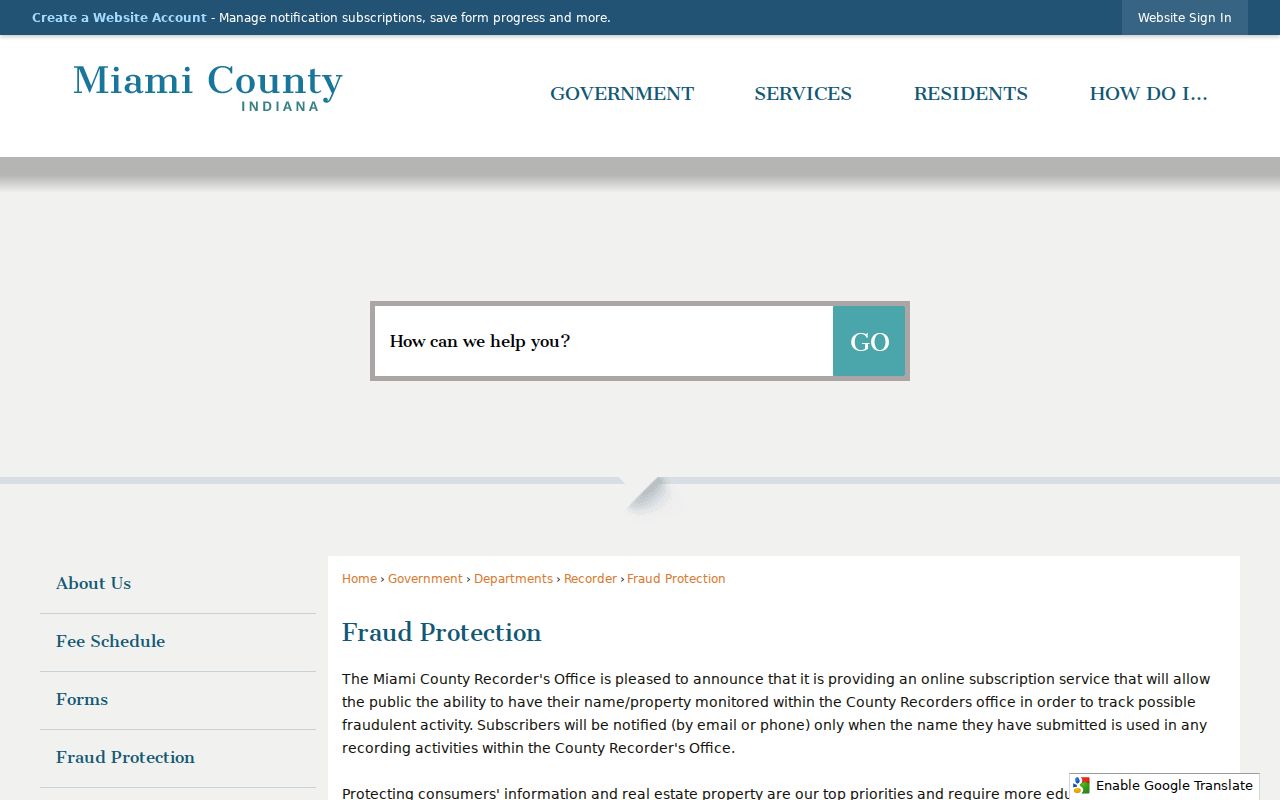
Its central limit is simple: notification lets an owner react, but it cannot stop an improper filing.
Limit a Miami County Owner Lookup
A name on a public tax roll proves little beyond ownership on paper. It does not show who occupies a building. It does not show whether an unrecorded claim exists. It does not show whether a deed is valid. A GIS map line is a reference feature too. It is not a surveyed boundary. For a purchase, an estate, an easement, or a title dispute, rely on the recorded instruments. And get qualified professional help suited to the stakes.
Lawful use. Miami County owner records support due diligence, estate work, boundary research, and civic transparency. Never use public information to stalk, harass, intimidate, or expose protected data.
Some protections apply to certain records. Indiana's Address Confidentiality Program can give qualifying victims a substitute address with mail forwarding. Protected voter details may also be withheld. If a public field is blank, respect that limit rather than hunting for a workaround. Keep only the personal data needed to identify the parcel. Verify conclusions with the custodian.